One line that made Opus 5 usable for me
The three magic words that turned it from a genius maniac to an efficient communicator

Talk to me like I have adhd.
That line went into Luo ji's (my AI employee) standing instructions. Then I went through 324 of its replies to me — 126 before I added the line, 198 after — to find out whether it did anything.
Here's what I found:
- The typical reply did not get shorter.
- Only the longest rambles got shorter.
- And its effect wears off. The writing gets denser again within two or three messages.
Here's my full chronicle.
The model I gave up on
Opus 5 launched to remarkable benchmarks and to one complaint that followed it everywhere: the thing will not stop talking.
It was not only length. It was a model performing its own intelligence — simple things said in complicated ways, stacked clauses, metaphors nobody asked for.
I made it the default model for Luo Ji, the AI agent that lives in my Slack, to judge it myself. Ten days later I caught myself being ruder to my own agent than usual, and swapped back to Opus 4.8.
But the FOMO never went away. Anthropic calls Opus 5 "a step-change improvement" over the 4.8 I had retreated to, at the same price.
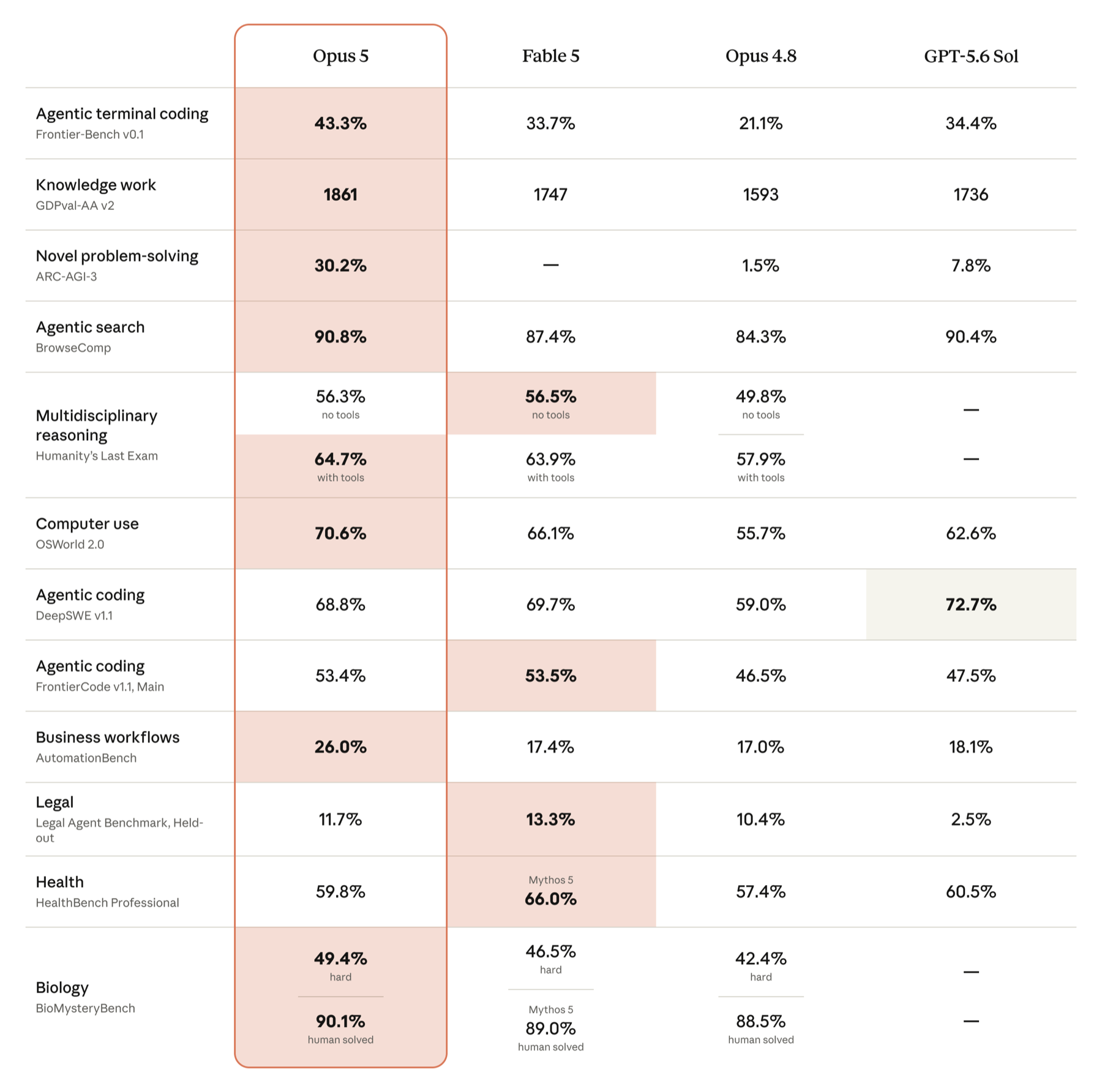
So I was choosing the model I believed was worse, because I could not stand reading the better one. Unacceptable!
The name, not the prompt
Then I saw a skill called i-have-adhd going around on X. It is at 22,800 stars now, and its entire job is the problem above.
The skill is good. But the part that stopped me was not its 140-line prompt. It was the name.
“I have ADHD”
A skill is something you or your agent invokes for a particular task; the rest of the time it is off. I wanted the opposite — a standing fact about who the model is talking to, true in every reply, that I never have to remember.
Anthropic prescribes roughly the same thing. Their prompting guide says the effort parameter will not shorten Opus 5, and that you should "prompt for it explicitly" instead.
The cheapest possible test
I typed it by hand first. My agent had just given me a long answer to a small question — should we ask a client for a folder of his past work before building our scoring system? — so instead of arguing I sent back:
tell me in fewer words - like i have adhdIt made the same argument again in a fifth of the words.
Because right now every judge is calibrated against my guesses, and the dump replaces my guesses with the client's recorded taste.
Here's the chain. The builders validated each eval two ways: an empty folder must score 0, and a synthetic fixture I invented must pass the script checks. That proves the machinery works — gates fire, parsers parse, the fabricated-quote detector catches fabrication. What it cannot prove is the thing the whole project exists for: that a genuinely good output scores high, and that a bad one fails for the reasons the client would fail it.
…four more paragraphs…
Our judges are guessing at the client's taste. His dump ends the guessing.
— He already reviewed his past outputs and told us which were great and which were trash — that's free labeled test data.
— We run our judges on them. Judge disagrees → we fix the judge, before real scores exist.
— His own bar on the call: "I should agree with the scores." Can't prove that without his outputs.
— Skip it and the risk is: first sweep lands, he disagrees on sight, benchmark loses credibility on day one.
Cost to him: zip one folder, send.
Real messages from my session log, 14 August, four minutes apart. Same recommendation, same reasoning, same client. Details redacted.
No rules, no examples, none of the 140 lines explaining what ADHD-friendly output means. The model already knew.
Elevating it to the system prompt
Typing it by hand worked every time, for four days. On 18 August I stopped typing it and put the settled version in my agent's CLAUDE.md, where it applies to every reply without my asking. Three words, wrapped in a sentence that makes them a standing instruction:
Talk to me like i have adhdI could feel it was working but I wanted receipts. I had friends who had reached the same frustration with Opus 5 and stopped using it.
So before I went back to them saying I had fixed it, I wanted to have receipts — a measurable answer to whether those three words had actually made the model easier to talk to.
What actually changed
My ai employee keeps every session log, so I had a real before/after. The first result was not what I expected. The typical reply did not get shorter at all — 202 words before, 218 after.
The instruction cut the longest replies. The typical reply stayed the same length.
My agent's replies to me, ranked by length and compared at five points. 126 replies before I added Talk to me like i have adhd to its system prompt, 198 after.
The two pairs on the right carry the finding. The three on the left are small moves on small numbers — the shortest 10% going from 16 words to 40 is most likely noise.
This is the part I would have got wrong by eye. The line did not compress everything. It cut the top off — the rambles. My longest replies, the 90th percentile, went from 498 words to 343.
That is the behaviour you want. A prompt that shortened every reply would also strip detail out of the replies that needed it.
Replies past 500 words — roughly two minutes of reading — went from 9.5% to 3.0%. One in 10, down to one in 33.
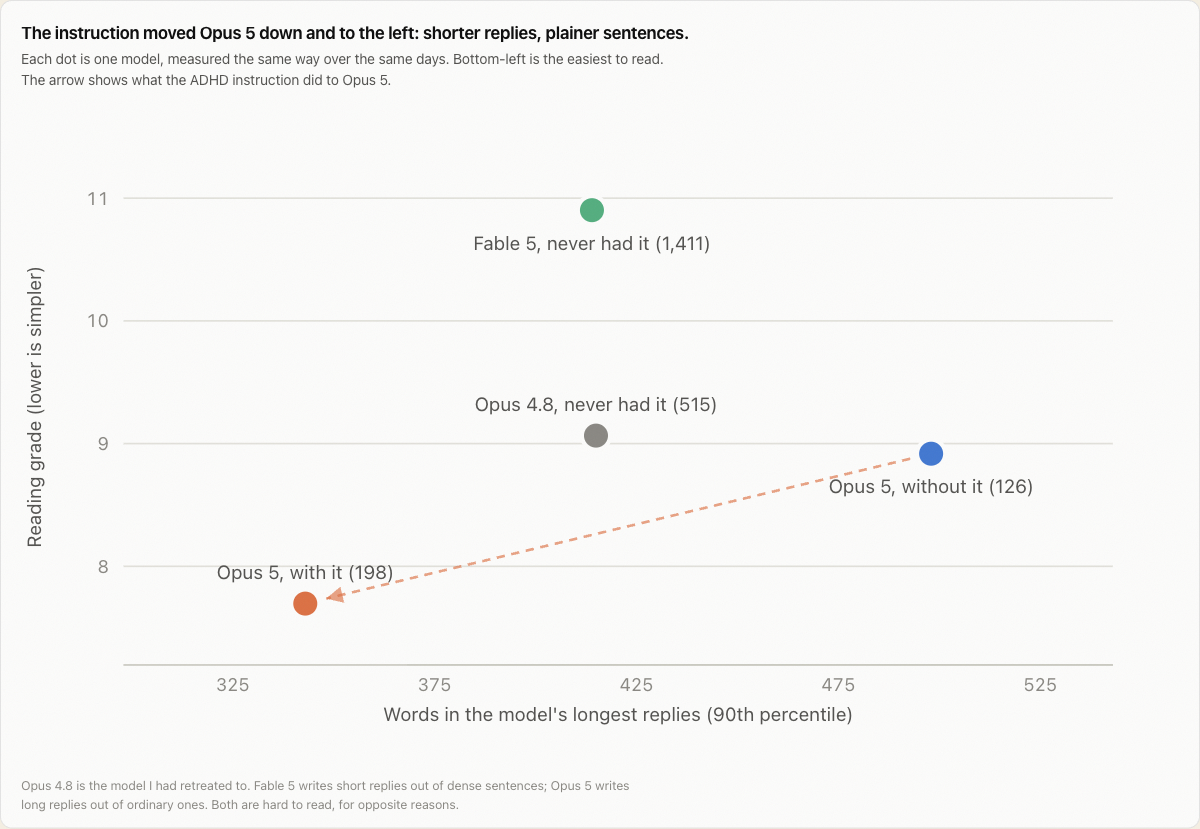
Length is only half of it. A short reply can still be dense, so I checked the writing itself — and put two other models beside it for scale, both running in the same house, on the same days, neither of them given the line.
The instruction moved Opus 5 down and to the left: shorter replies, plainer sentences.
Each dot is one model, measured the same way over the same days. Bottom-left is the easiest to read. The arrow shows what the ADHD instruction did to Opus 5.
Opus 4.8 is the model I had retreated to. Fable 5 writes short replies out of dense sentences; Opus 5 writes long replies out of ordinary ones. Both are hard to read, for opposite reasons.
The catch: it wears off
The effect did not last through a conversation. The first few replies would be clean, then the old voice would creep back and I would find myself typing "say that simply" again.
The line sits in the system prompt, at the very start of the context window. The model seemed to forget it as the conversation went on.
So I changed my agent's harness instead of arguing with it. Every 4th message I send now has the line stapled onto the end of it, on top of the copy already in the system prompt. I never see it; the model never stops seeing it.
Every 4th message I send gets the instruction stapled to the end
I never see the orange text. The model never stops seeing it.
wait are you sure? open something in chrome on pro if you're running on pro right now. also i added the ssh key on air.
The orange text is appended by my Slack harness. It is not something I type, and not something I see.
That also gives a clean test. If the instruction fades, replies should get harder to read the further they are from the last reminder.
The writing gets harder to read with every message after a reminder
Every reply since the reminders started, grouped by how many of my messages have passed since the last one. The dashed line is what the model wrote before the ADHD line existed.
Sentence length follows the same shape. The chart stops two messages past the reminder, which is where the next one is due.
Three points and 33 replies is thin, and the climb could be chance. So the chart is a hint about why the reminders maybe worth sending. I added reminders and the vibes felt better - so I'm keeping it.
A more rigourous test would involve making the setup do a randomized trial.
Everything I measured
I measured thirteen data points from my own session logs. Nine of them show movements in the favourable direction with this prompt interjection.
Nine of thirteen measures moved toward shorter and plainer
Median across my agent's replies to me, on Claude Opus 5. Read each row left to right: no instruction, then Talk to me like i have adhd in the system prompt, then a reminder every 4th message on top of that. Shaded rows moved toward shorter and plainer; the unshaded ones have no good direction.
Scroll sideways for the two models that never had the instruction →
| Measure | No instruction 126 replies | In the system prompt 94 | System prompt + reminders 104 | Opus 4.8 never had it 515 | Fable 5 never had it 1,411 |
|---|---|---|---|---|---|
| A typical reply, words | 202 | 228 | 200 | 155 | 163 |
| Longest replies (90th percentile), words | 498 | 355 | 327 | 415 | 414 |
| Replies over 500 words, % | 9.5 | 3.2 | 2.9 | 4.9 | 5.4 |
| Gap between a short and a long reply (middle half), words | 275 | 170 | 166 | 252 | 221 |
| Shortest replies (10th percentile), words | 16 | 48 | 30 | 14 | 23 |
| Replies under 100 words, % | 25.4 | 18.1 | 22.1 | 38.3 | 33.7 |
| Longest paragraph, words | 64 | 64 | 54 | 61 | 78 |
| Sentences per reply | 12 | 15 | 12 | 8 | 7 |
| Words per sentence (fewer is simpler) | 16.4 | 15.0 | 13.8 | 16.7 | 20.2 |
| Reading grade (lower is simpler) | 8.9 | 7.9 | 7.6 | 9.1 | 10.9 |
| Reading ease (higher is simpler) | 59.8 | 65.4 | 65.3 | 60.6 | 53.1 |
| Words of 3+ syllables, % | 12.6 | 11.0 | 10.7 | 12.2 | 13.4 |
| Opening sentence, words | 7 | 6 | 6 | 9 | 14 |
The last two columns are two models that never had the instruction, measured the same way over the same days. They are there for scale, not as a before and after.
What to copy
1. Put the line in your agent's standing instructions. Claude Code: CLAUDE.md. Cursor: your rules file. ChatGPT: custom instructions. Anything else with a system prompt: the system prompt. The string is Talk to me like i have adhd, exactly as written.
2. Re-send it inside the conversation. This is the part I have not seen anyone else do. If you can script the messages you send — a hook, a wrapper, a bot — append the line every few turns. If you cannot, paste it yourself the moment a reply starts running long.
Mine fires every 4th message. The drift is already visible one reply after a reminder, so I am moving to every 2nd. Start there.
What this is not
One person, one agent, Claude model family. The data was collected over a span of a few days from my real world chats with my AI employee where I did all sorts of work. But it's still just one person's Claude session logs.
The rigourous version of this test would be to randomise at the time of data collection and collect more samples. I have not done it and I don't intend to. I set out to make Opus 5 workable for me and it is now - with data to back it up.
So if you are in my shoes, try my simple intervention. It could just make you love that weird Opus 5 brain.